

How to Perform a Barbell Shoulder Press Correctly
The barbell shoulder press is a foundational strength exercise designed to build powerful shoulders and upper-body stability.
Step-by-Step Technique
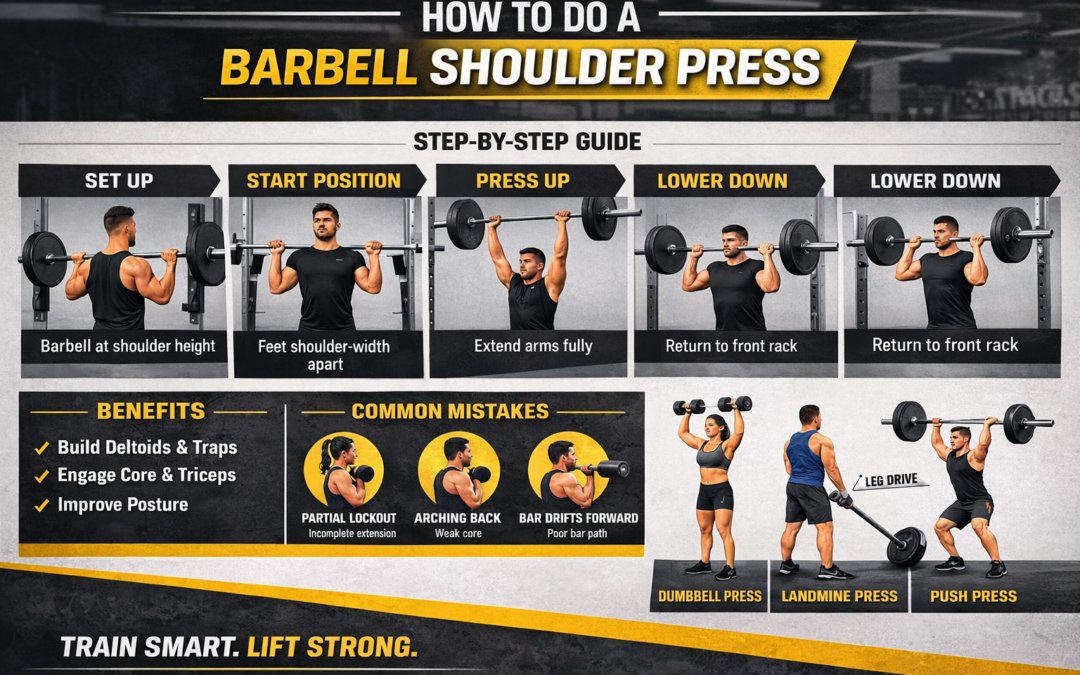
Begin by setting the barbell on a power rack at a height just below shoulder level. You should be able to unrack the bar comfortably without rising onto your toes or excessively bending your knees.
Stand tall with your feet positioned about shoulder-width apart. Keep your hips and knees extended while maintaining a slight softness in the knees—avoid locking them out. Grip the bar slightly wider than shoulder width and rest it across the front of your shoulders in a front-rack position, with your elbows pointing forward.
Brace your core, draw your shoulder blades down and back, and initiate the press. As you exhale, drive the barbell upward in a straight line until your arms are fully extended overhead. Your head should naturally move slightly back and then forward, finishing directly under the bar.
Lower the barbell slowly and with control back to the front of your shoulders while inhaling. Repeat for the desired number of repetitions. When finished, safely return the bar to the rack.
If no rack is available, the exercise can be performed from the floor with assistance from a spotter, especially when lifting heavier loads.
Benefits of the Barbell Shoulder Press
This compound movement primarily targets the deltoid muscles and trapezius while also activating stabilizing muscles deep within the shoulders. Secondary muscles involved include the triceps, upper back, arms, and core, making it an effective full upper-body exercise.
Because of its straightforward movement pattern, the barbell shoulder press is suitable for beginners and advanced lifters alike. Research also suggests it can enhance trunk stability and spinal movement, particularly in female athletes.
Strengthening the shoulders and core contributes to improved posture, which may help reduce discomfort in the neck and upper back. Additionally, this lift carries real-world benefits by improving your ability to press or place objects overhead in everyday life.
Barbell Shoulder Press Variations
You can modify the shoulder press to match your experience level, mobility, or available equipment.
Dumbbell Shoulder Press
Using dumbbells allows each arm to work independently, which can reduce joint stress and help correct strength imbalances. Start with the weights at shoulder height and press upward while keeping your torso upright and core engaged.
Single-Arm Dumbbell Press
Pressing one dumbbell at a time increases core activation and is useful for individuals with limited spinal mobility or recovering from injury.
Seated Shoulder Press
Performing the press while seated on a bench removes lower-body assistance and places greater demand on core control and upper-body strength.
Landmine Press
This angled pressing variation is ideal for those with shoulder limitations. With one end of the barbell anchored to the floor, press the free end upward and forward at an angle rather than directly overhead.
Push Press
By incorporating a small knee bend and hip drive, the push press allows you to move heavier loads overhead using lower-body momentum.
Push Jerk
A more advanced explosive variation, the push jerk includes a second dip to receive the barbell overhead, commonly used in Olympic lifting and CrossFit.
Clean and Press
This full-body movement combines a power clean with an overhead press, improving strength, coordination, and athletic performance.
Kettlebell Press
Kettlebells challenge shoulder stability and control due to their offset load. Press them overhead from the front-rack position while keeping the arms close to the head.
Common Mistakes to Avoid
Failing to fully extend the arms overhead limits muscle activation and reduces the effectiveness of the lift. Unless restricted by injury, aim for a full lockout.
Poor core engagement often leads to excessive lower-back arching, increasing injury risk. Maintain a tight, braced midsection throughout the movement.
Allowing the barbell to drift forward creates unnecessary strain and makes the lift harder. The bar should travel vertically in a straight path.
Using leg drive unintentionally turns the movement into a push press. If your goal is a strict shoulder press, keep the lower body stable.
Safety Tips and Preparation
Always warm up before pressing overhead. Focus on dynamic shoulder mobility drills and lighter pressing sets to prepare the joints and muscles. Core activation exercises are also recommended prior to loading the bar.
If you have a history of shoulder, neck, or back injuries, consult a medical professional before performing this exercise. Discontinue immediately if you experience pain.
For most lifters, aiming for 8–10 controlled repetitions per set is effective. If your form breaks down, re-rack the bar and reset before continuing.
Add the barbell shoulder press to your training program to build strong, stable, and functional shoulders.